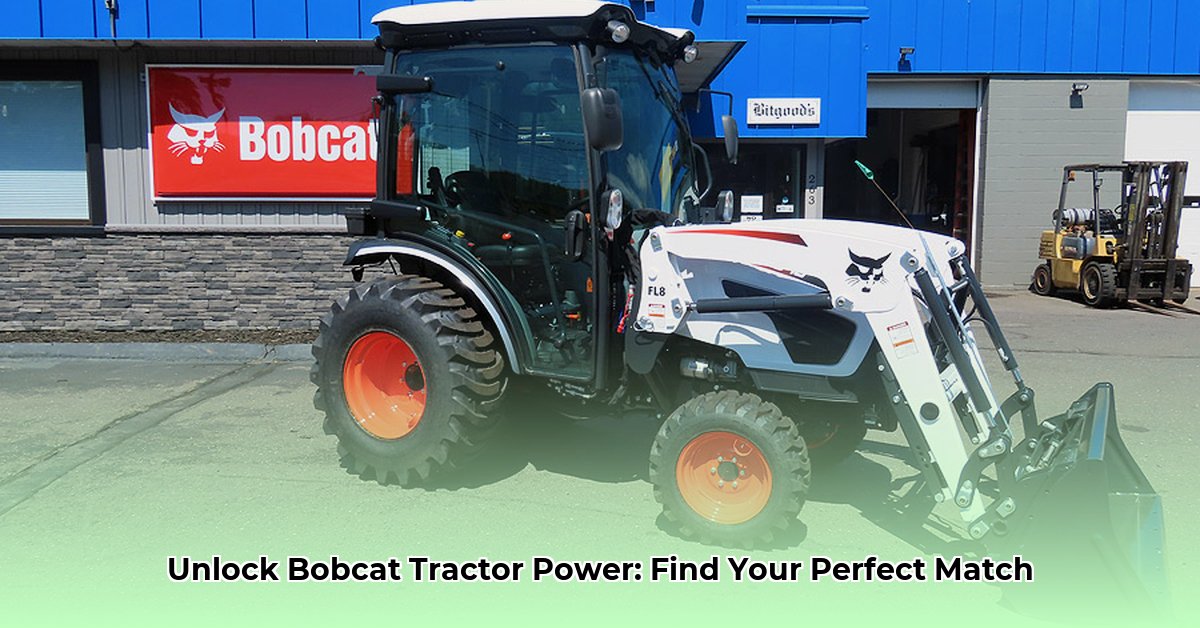
Choosing the right Bobcat tractor can seem daunting, but this guide simplifies the process. Whether you're a homeowner or a professional, we'll help you find the perfect machine for your needs and budget. We'll cover Bobcat's tractor lines (1000, 2000, 4000, 5000, and Utility series), compare features, and discuss maintenance. For comparisons with other brands, check out tractor reviews.
Understanding Your Needs: Which Bobcat Tractor is Right for You?
Before exploring Bobcat's lineup, honestly assess your requirements. This self-assessment is crucial for a smart purchase.
- Primary Tasks: What will your tractor primarily do? Mowing? Tilling? Hauling? Heavy lifting? The tasks dictate the necessary power and features.
- Property Size: A small garden needs a compact tractor; a large farm requires a more powerful machine. Acreage directly impacts the tractor's required capabilities.
- Budget: Bobcat tractors range in price; establish a realistic budget before you start shopping. This helps narrow the field considerably.
- Transmission Preference: Do you prefer the ease of a hydrostatic (automatic-like) transmission or the precise control of a manual (synchro-shuttle) transmission? Your experience level and typical tasks influence this choice.
Exploring the Bobcat Tractor Family: A Diverse Lineup
Bobcat offers tractors for various applications:
- 1000 Series: Compact and ideal for smaller properties, landscaping, and light gardening. Maneuverability is a key advantage.
- 2000 Series: More powerful than the 1000 series, suitable for hobby farms, larger landscaping projects, and hay baling. Offers a balance of power and maneuverability.
- 4000 & 5000 Series: Heavy-duty tractors for larger farms and demanding tasks. Expect robust power, significant lift capacity, and suitability for heavy tillage and hauling.
- Utility Series: These tractors prioritize versatility and power, excelling in heavy-duty applications requiring a three-point hitch and various attachments.
Transmission Types: Hydrostatic vs. Manual – A Detailed Comparison
Bobcat tractors use hydrostatic or manual (synchro-shuttle) transmissions.
Hydrostatic Transmission: Offers smooth, effortless operation, making it user-friendly for beginners. However, it might be less fuel-efficient than a manual transmission in some uses.
Manual (Synchro-Shuttle) Transmission: Provides greater control and potentially better fuel efficiency, favored by experienced operators. It requires more skill and can be more tiring during prolonged use. Consider your experience level and the nature of your work when making this choice. A test drive would be beneficial.
Bobcat Tractor Model Comparison: Key Differences Highlighted
This table offers a general comparison. Always consult the official Bobcat specifications for precise details on individual models.
| Platform | Typical Horsepower Range | Transmission Options | Approximate Lift Capacity (lbs) | Typical Max Ground Speed (mph) | Cab Option Availability | Typical Use Cases |
|---|---|---|---|---|---|---|
| 1000 Series | 20-25 | Usually Hydrostatic | 700-900 | 10-12 | Typically No | Small properties, landscaping, light gardening |
| 2000 Series | 25-40 | Hydrostatic and Manual Options | 1500-1800 | 12-15 | Often Yes | Hobby farms, larger landscaping, hay baling |
| 4000 Series | 45-60 | Hydrostatic and Synchro-Shuttle | 2500-3000 | 15-18 | Typically No | Larger farms, heavier tillage, significant material hauling |
| 5000 Series | 45-60 | Electronic Hydrostatic | 3000-3500 | 15-18 | Often Yes | Large-scale farming, demanding agricultural tasks |
| Utility Series | 60-75 | 12x12 Powershuttle | N/A (Category 2 3-point hitch) | Varies depending on model | Typically No | Heavy-duty applications requiring a three-point hitch |
Expanding Your Tractor's Capabilities: Bobcat Attachments
Bobcat's wide range of attachments enhances versatility. Think loaders, backhoes, tillers, mowers—consider which attachments best suit your needs. This significantly broadens the tractor's utility beyond its core functions.
Maintenance and Care: Extending Your Tractor's Lifespan
Regular maintenance is key. This includes oil changes, filter replacements, and proper storage. Consult your owner's manual for a detailed schedule. Preventative maintenance saves money and extends the tractor's lifespan.
Making Your Final Decision: A Checklist for Success
Before purchasing, review this checklist:
- Clearly Defined Needs: Have you accurately assessed your tasks and acreage?
- Appropriate Horsepower and Lift Capacity: Does the chosen model meet your power requirements?
- Suitable Transmission Type: Have you considered hydrostatic versus manual?
- Essential Attachments: Do you have the necessary attachments?
- Realistic Budget: Does the total cost (tractor, attachments, maintenance) fit your budget?
By carefully considering these factors, you’ll confidently choose the right Bobcat tractor for your needs. Visit your local Bobcat dealer for test drives and further information.